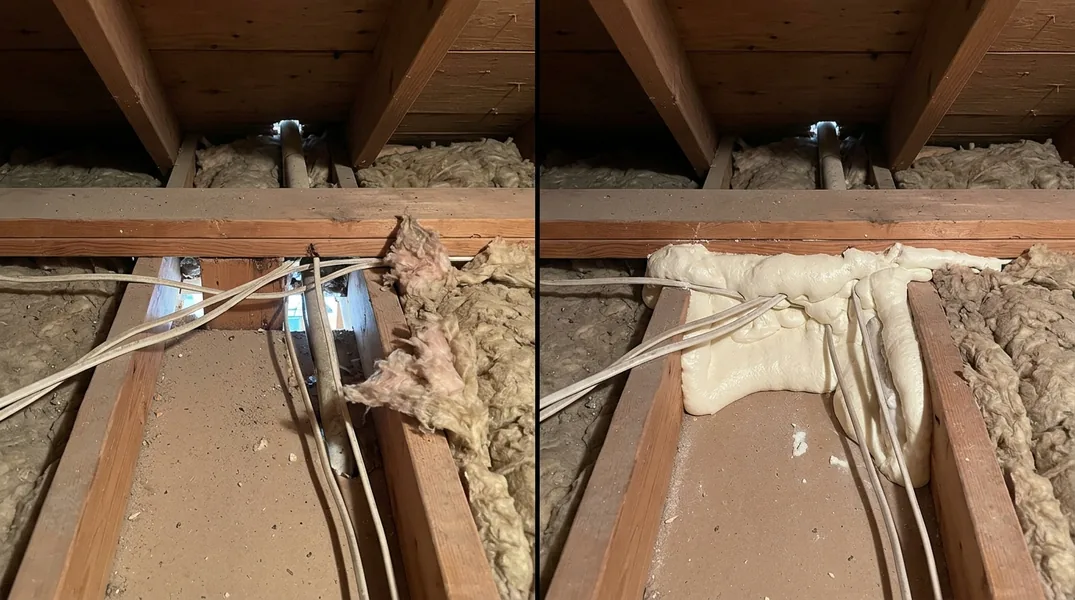
Understanding Air Sealing vs. Full Spray Foam Insulation
When it comes to improving your home's energy efficiency, homeowners in Rochester often face a critical decision: should you invest in air sealing alone, or does your home need comprehensive Attic Spray Foam Insulation? The answer depends on your home's current condition, your budget, and your long-term energy goals.
Air sealing addresses the small cracks, gaps, and leaks throughout your home where conditioned air escapes. It's a targeted approach that can significantly reduce energy loss when performed correctly. However, air sealing alone doesn't add insulation value or R-value to your attic. Full spray foam insulation, by contrast, combines air sealing benefits with substantial thermal resistance, creating a complete thermal barrier that protects your entire home. Understanding the difference between these two approaches will help you make an informed decision that aligns with your property's specific needs and your budget constraints.
What Is Spray Foam Insulation R-Value Per Inch?
The R-value of insulation measures its thermal resistance, or how effectively it slows heat transfer. When evaluating spray foam insulation R-value per inch, it's important to understand that different types of spray foam perform differently. Closed Cell Spray Foam Insulation typically delivers an R-value of 6.0 to 7.0 per inch, making it one of the most efficient insulation materials available. Open Cell Spray Foam Insulation, while less dense, provides an R-value of approximately 3.5 to 3.6 per inch and is often more budget-friendly.
The higher R-value per inch of closed cell foam means you need less thickness to achieve your target insulation level. For homeowners in Rochester with limited attic space or those seeking maximum efficiency, closed cell foam offers superior performance. However, the choice between closed and open cell foam also depends on moisture management needs, air sealing requirements, and your overall energy efficiency goals. Both types create an air seal while providing insulation, but their performance characteristics differ significantly.
How Thick Should Spray Foam Be in Your Rochester Attic?
Determining how thick spray foam should be in your attic depends primarily on your state's R-value requirements and your home's climate zone. Minnesota, where Rochester is located, falls in climate zone 6, which requires higher insulation values to combat harsh winters and protect against energy loss. The recommended R-value for attic insulation in Minnesota typically ranges from R-38 to R-49, depending on your specific location and building codes.
If you're using closed cell spray foam with an R-value of 6.5 per inch, you would need approximately 6 to 7.5 inches to meet Minnesota's requirements. Open cell foam, with its lower R-value per inch, would require 11 to 14 inches of thickness to achieve the same protection. The thickness decision also affects your project budget and the space available in your attic. During a free estimate, our team at Rochester Spray Foam Insulation can assess your attic dimensions and recommend the optimal thickness for maximum efficiency and code compliance.
R-Value Requirements by State: Minnesota's Standards
Understanding R-value requirements by state is essential for any homeowner planning an insulation upgrade. Minnesota's building codes, which apply to homes throughout the Rochester area, specify minimum R-value requirements based on the building component and climate zone. For attics in Minnesota, the current standard is R-38 minimum, though many energy-efficient builders and homeowners aim for R-49 to R-60 for superior performance and future-proofing against rising energy costs.
These requirements exist because Minnesota experiences significant temperature variations, with winters dropping well below freezing and summers reaching uncomfortable heat levels. Proper insulation reduces the workload on your HVAC system year-round, lowering energy bills and extending equipment lifespan. When considering spray foam thickness and type, ensure your chosen solution meets or exceeds Minnesota's minimum standards. This is particularly important if you're planning to sell your home, as buyers and inspectors will verify code compliance. Our team can explain how your chosen insulation type and thickness will satisfy these requirements and provide long-term energy savings.
Insulation Tax Credits and Rebates: Reducing Your Out-of-Pocket Cost
One of the most attractive aspects of upgrading your home's insulation is the potential to offset costs through insulation tax credits and rebates. The federal government offers tax credits for homeowners who make qualifying energy-efficiency improvements, including spray foam insulation. These credits can cover a percentage of your project costs, making a comprehensive insulation upgrade more affordable than many homeowners realize.
Minnesota also offers various rebate programs through utility companies and state energy programs designed to encourage residential energy efficiency. Many homeowners can recover 10 to 30 percent of their insulation project costs through these incentives. To maximize your savings, it's important to work with a qualified contractor who understands current tax credit requirements and can help you document your project properly. When you contact Rochester Spray Foam Insulation at (507) 577-5314 for your free estimate, ask about available tax credits and rebates in your area. Our team stays current on federal and state incentive programs and can guide you through the application process to ensure you capture every dollar of savings you're entitled to receive.
Attic Spray Foam Insulation Near Me: When to Call a Professional
If you're searching for attic spray foam insulation near you in the Rochester area, now is the time to reach out to a qualified professional. While air sealing is sometimes a DIY-friendly project for small gaps, spray foam insulation requires specialized equipment, training, and safety protocols. Improper application can result in inadequate coverage, poor air sealing, or even structural issues if foam expands unevenly or into spaces where it shouldn't go.
Professional spray foam contractors like Rochester Spray Foam Insulation have the expertise to assess your attic's current condition, calculate the precise thickness needed to meet Minnesota's R-value requirements, and execute the installation safely and effectively. We also help you navigate Wall & Injection Foam Insulation options if your home needs additional air sealing in walls or other cavities. The investment in professional installation pays dividends through superior performance, proper code compliance, and the ability to claim tax credits and rebates. Contact us today at (507) 577-5314 or request a free estimate to discuss your home's insulation needs and explore the best solution for your budget and goals.
Looking for a professional spray foam insulation contractor in Rochester? Rochester Spray Foam Insulation responds fast for all your spray foam insulation needs.
Get a Free Quote