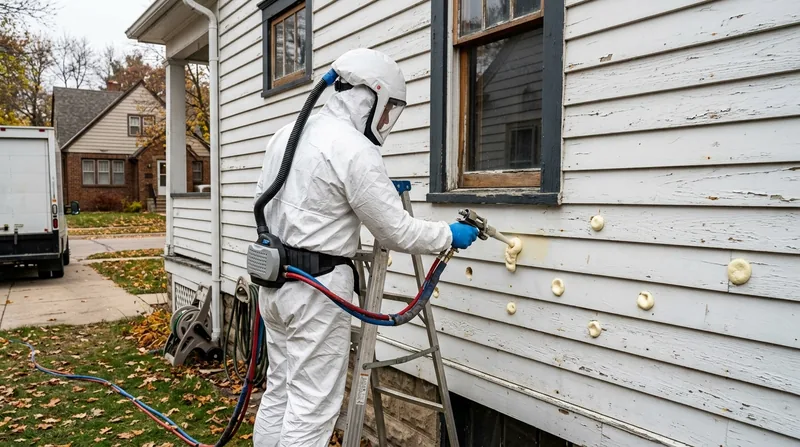




Wall & Injection Foam Insulation in Rochester fills closed wall cavities in older homes without opening plaster or drywall, restoring heat retention through long Zone 6A winters. Rochester's housing stock, from pre-1950 brick homes near downtown and Kutzky Park to mid-century ranches and split-levels across the city, sits over full basements with rim joists that bleed heat, but the walls themselves often remain untouched. Injection foam reaches into those closed cavities, sealing air leaks and adding R-value where blown-in fiberglass cannot go. This is especially critical in older neighborhoods where exterior demolition is neither affordable nor desirable, and where the stack effect drives heated air upward through wall penetrations and into attics. We help Rochester homeowners hold onto the heat their furnaces are producing, without gutting walls or disrupting the character of the home.
Why Wall & Injection Foam Matters in Rochester's Older Homes
Rochester's older residential core, downtown, near parks, and in established neighborhoods across Olmsted County, was built when energy codes did not exist. Walls in those homes are often hollow, uninsulated cavities with only air and sometimes old newspaper or sawdust acting as insulation. Modern heating demands expose those voids immediately: winter air seeps in around windows and door frames, and the stack effect pulls warm air from living spaces upward through every crack and penetration. Injection foam seals those cavities from the inside without disturbing plaster, siding, or trim, and it does so with precision and control. The alternative, removing exterior siding or interior drywall to access the cavity, costs far more and leaves the home disrupted for weeks.
- We drill small holes through plaster or drywall into the cavity, inject low-pressure foam, and seal the holes with matching plugs.
- The foam expands to fill voids, sealing air leaks and adding thermal resistance without disturbing the wall structure.
- Injection foam works in walls that are already finished and occupied, so you stay in your home during the work.
- This method is the only practical retrofit for pre-1980 stock where opening walls is not an option.
Injection foam turns a wall from a thermal sieve into a functioning thermal barrier, which is why it is the standard retrofit for older Rochester homes that cannot afford or tolerate full demolition.
Key info: Rochester homes built before 1970 almost always have hollow, uninsulated walls. A typical older home near downtown or in mid-century neighborhoods can lose 15 to 25 percent of its heating energy through walls alone. Injection foam closes that gap without renovation.
For more context on how spray foam works in different applications, see our closed cell spray foam insulation page, which covers the density and R-value that make injection foam effective in tight cavities.
How We Inject Foam into Rochester Walls: The Process
Wall injection foam is a controlled process that begins with a careful assessment of the cavity. We locate studs, check for existing insulation or obstructions, and determine the best entry points. We use low-pressure injection equipment to fill the cavity slowly, allowing the foam to expand and settle without forcing it into adjacent spaces or creating pressure on the wall. The work is clean, the smell is temporary, and the result is a sealed, insulated cavity that holds heat for decades.
- We inspect the wall cavity using a borescope or moisture meter to confirm it is dry and free of active leaks before injecting.
- We drill access holes (typically 1.5 inches) at intervals along the cavity, starting at the bottom and working upward.
- We inject foam slowly and at low pressure, monitoring the cavity as it fills to avoid overfilling or damaging the wall.
- We seal the holes with foam-compatible plugs and finish them to match the existing wall surface.
- We provide written documentation of the cavity depth, foam type, and estimated R-value added.
The entire process typically takes one to two days for a typical wall section, and the home remains occupied and heated throughout.
Example: A 1960s ranch in Stewartville with original plaster walls and no insulation between studs. We inject foam into three exterior walls facing north and west (the cold sides). The cavity is 3.5 inches deep, studs are 16 inches on center, and we use low-density foam to fill without overpressure. Total added R-value is roughly R-12 to R-15 per wall, a significant upgrade for a retrofit that does not disturb the interior or exterior finish.
For complementary work like air sealing around windows and doors, see our air sealing service page.
Wall & Injection Foam Methods: When Each Applies
| Approach | Description | Best for |
|---|---|---|
| Low-Density Injection Foam | Expands gently to fill cavities, low pressure, safe for plaster and old walls. | Pre-1980 homes with plaster or drywall interiors, cavities 3.5 to 5.5 inches deep. |
| Medium-Density Injection Foam | Higher R-value per inch, moderate expansion pressure, requires careful monitoring. | Cavities with sufficient depth and structural integrity, where R-value per inch is a priority. |
| Cavity Assessment & Dry-Out | We check moisture and confirm the cavity is dry before injecting; wet cavities are not treated. | Any wall with a history of leaks or moisture; we walk away if the cavity is wet. |
| Partial vs. Full Wall Injection | We can inject select cavities (north or west facing) or the entire wall perimeter, depending on budget and need. | Phased retrofits where homeowners prioritize the coldest exposures first, then expand later. |
Wall & Injection Foam Insulation Cost in Rochester: What to Expect
Wall injection foam typically starts at $2 per square foot of wall area injected, with realistic ranges from $2 to $4 per square foot depending on cavity depth, foam density, and access. A typical 1,500-square-foot ranch with one or two exterior walls injected (roughly 400 to 600 square feet of wall area) falls in the $800 to $2,400 range. Factors that affect the final cost include the depth of the cavity (deeper cavities allow higher R-value and may use denser foam), the number of studs and cross-bracing (more interruptions mean more drilling and slower injection), whether the wall is accessible from inside or requires exterior scaffolding, and the condition of the plaster or drywall (repairs to damage discovered during drilling are additional). We always provide a written estimate that specifies the cavity depth, foam type, estimated R-value, and total cost before any work begins.
The best way to understand cost for your specific home is to get a free on-site estimate. Call us at (507) 577-5314 or request an estimate through our contact page. We will inspect the walls, measure the cavities, and provide a firm price with no hidden fees. For a broader view of spray foam pricing across all our services, see our full pricing page.
What to Look for When Hiring a Wall & Injection Foam Contractor Near Rochester
Wall injection foam is a precision job, and the difference between a careful installer and a careless one shows up in the quality of the seal and the durability of the repair. When you are comparing contractors, here are the key things to verify. First, confirm that any contractor you hire carries full insurance and can provide a certificate of insurance on request. Ask for references from at least two previous jobs in Rochester or nearby towns like Byron, Stewartville, or Kasson, and call those homeowners to ask how the work held up and whether they experienced any odor or moisture issues. Ask to see a written estimate that includes the cavity depth, the foam type and density, the estimated R-value, and the total cost broken down by wall or section. Any estimate that omits these details is a red flag. Third, ask about the installer's process for checking moisture before injection: any contractor who injects into a wet cavity is cutting corners. Finally, understand that permitting rules and registration requirements vary by city in Olmsted County and surrounding areas, and while most wall injection work does not require a permit, some cities may require notification to the building department. We help you navigate what applies at your address, and we defer to your local building official for any requirements specific to your property.
If you are ready to move forward, contact us for a free estimate. We will walk you through the process, answer your questions, and provide a clear price before we start.
Wall & Injection Foam Insulation in Rochester: Pricing Guide
| Service | Price | Details |
|---|---|---|
| Wall Injection Foam, Low-Density | Starting at $2/sq ft | Fills 3.5-inch cavities, adds R-12 to R-15 per wall, ideal for pre-1980 plaster homes |
| Wall Injection Foam, Medium-Density | Starting at $2.50/sq ft | Higher R-value per inch, deeper cavities, requires careful pressure monitoring and structural assessment |
| Cavity Assessment & Moisture Check | Included in estimate | We inspect and verify dryness before injecting; wet cavities are not treated, we walk away |
| Phased or Partial Wall Injection | Calculated per section | Inject north or west facing walls first, expand to other exposures later as budget allows |
| Travel within Rochester and surrounding areas | Included | No separate mileage fee for Byron, Stewartville, Kasson, Oronoco, Pine Island, or nearby towns |
| Free written estimate with R-value and thickness | Free | Response within 24 hours at (507) 577-5314, no obligation to book, firm price before work starts |
Indicative pricing, the exact cost depends on square footage, finish, and site access. Free personalized estimate within 24h at (507) 577-5314.


