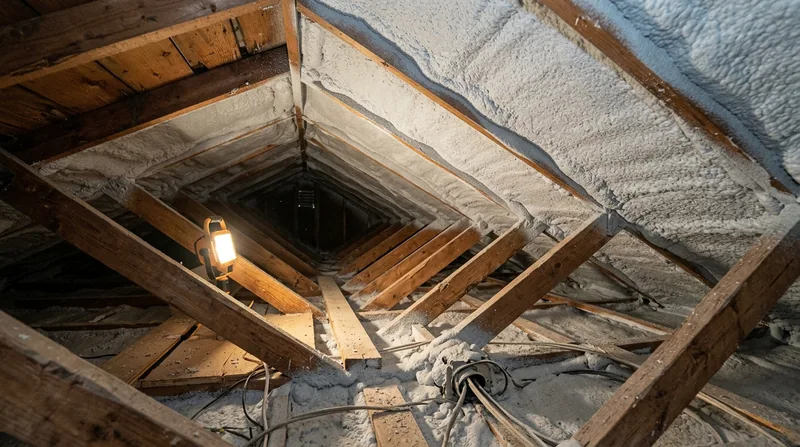




Open cell spray foam insulation in Rochester fills wall cavities and attic framing in the older neighborhoods near downtown, across the mid-century ranch and split-level stock, and in the newer subdivisions stretching toward Byron, Stewartville, and Pine Island. Rochester sits in IECC climate zone 6A, where long cold winters with snow and wind drive heat loss upward through attic bypasses and down through uninsulated rim joists at the foundation. Open cell foam expands to seal those air leaks, quiet sound transmission between rooms, and stop the stack effect that feeds ice dams once winter settles in. Unlike closed cell foam, open cell is lighter, more cost-effective for attic work, and easier to install in tight framing on homes built before 1980. We have served Olmsted County and the surrounding counties of Mower, Fillmore, Winona, Wabasha, and Goodhue since 2014, and we help homeowners understand when open cell is the right choice and when closed cell spray foam makes more sense.
Why Open Cell Spray Foam Matters in Rochester's Attics and Walls
Rochester's housing stock is built for cold winters. Nearly every home sits over a full basement, and the rim joist at the top of the foundation wall is a constant source of heat loss and condensation. Attics on older homes and on the ranch and split-level roofs across the city are prone to ice damming once heat escapes past attic bypasses, and that stack effect, combined with uninsulated rim joists and garage-adjacent rooms, is the main driver of winter heating bills across the region. Open cell foam addresses this by sealing the air leaks that create the stack effect, and it does so at a lower cost per square foot than closed cell, making it the practical choice for many Rochester homeowners looking to cut heating loss without a premium price tag.
- Open cell foam expands to fill cavities completely, sealing attic bypasses that otherwise feed warm air into the attic and drive ice dams.
- It reduces sound transmission between rooms and from outside, a real benefit in older neighborhoods near Kutzky Park and Slatterly Park where homes sit closer together.
- Open cell is lighter and easier to handle than closed cell, and it cures faster, so jobs finish with less disruption to your home.
- It costs less per board foot than closed cell, making it the right answer when your attic is sound and you are topping up insulation or sealing bypasses, not controlling condensation on steel or in a crawl space.
Getting the right foam for your job is the difference between a smart retrofit and money spent wrong.
Key info: Rochester's winter air is dry, and the stack effect pulls that dry air upward through wall cavities and attic bypasses. Open cell foam stops that upward pull, preventing the warm interior air from escaping and the cold exterior air from leaking in. In summer, when humidity rises and the vapor drive reverses, open cell's permeability lets moisture move harmlessly through the foam rather than trapping it at the cold surface where condensation forms.
For more on how attic spray foam insulation works in Rochester's climate, see our attic page.
How We Install Open Cell Spray Foam in Rochester Homes
Open cell spray foam installation is a controlled process. We start with a site visit to assess your attic or wall cavity, measure the space, and identify any existing insulation that needs to be removed first. We then set up mechanical ventilation to manage off-gassing during the cure period, spray the foam in passes of the correct thickness (typically 5.5 inches for R-19 or 7 inches for R-23), and allow the proper re-entry window of 24 to 48 hours before you occupy the space. The foam expands as it cures, filling every corner and sealing air leaks that fiberglass batts and blown-in cellulose cannot reach. Once cured, open cell is stable, non-settling, and does not absorb water the way fiberglass does.
- We schedule a free estimate and walk your attic or wall space to confirm the scope and identify any moisture, contamination, or structural issues before we commit to a price.
- We remove any failed or wet insulation and address the moisture source, or we walk away.
- We set up mechanical ventilation and seal off the space so off-gassing does not enter your living areas.
- We spray the foam in controlled passes, matching the manufacturer ratio and drum temperature, and we specify the R-value and thickness in writing before we start.
- We honor the re-entry window and provide clear guidance on when the space is safe to occupy.
This process is the standard in the trade, and it is what separates a professional installation from a rig-and-run crew.
Local example: A ranch home in Stewartville with a 1970s attic and original fiberglass batts settling over the rim joist. We removed the old batts, sealed the rim joist with open cell foam to R-19, and sprayed the attic deck to R-23. The homeowner reported no ice dams the following winter and lower heating bills. The job took one day, and the re-entry window was 36 hours.
To learn more about air sealing and how it works alongside spray foam, visit our air sealing page.
Open Cell Spray Foam Installation Methods for Rochester Properties
| Approach | Description | Best for |
|---|---|---|
| Attic deck spray | Open cell foam sprayed directly onto the attic subfloor or rafter underside, 5.5 to 7 inches thick for R-19 to R-23. | Older attics with failed batts, settling insulation, or air leaks at bypasses and penetrations. |
| Sealed roof deck | Open cell foam sprayed to the underside of the roof sheathing, sealing the attic as a conditioned space and eliminating ventilation requirements. | Homes with ice dam problems, finished attic rooms, or where ventilation is compromised by soffit blockage. |
| Rim and band joist sealing | Open cell foam injected or sprayed into the rim joist cavity at the top of the foundation wall, sealing the largest air leak in most Rochester basements. | Any Rochester home with a basement, especially those with cold basement rooms or high heating bills. |
| Wall cavity retrofit | Open cell foam injected into closed wall cavities through small holes, filling around wiring, plumbing, and framing without demolition. | Pre-1980 homes with hollow walls and no insulation, or homes where exterior demolition is not an option. |
| Garage ceiling spray | Open cell foam sprayed to the underside of the garage roof or the floor of the room above, sealing the thermal boundary between conditioned and unconditioned space. | Garage-adjacent bedrooms and living spaces that stay cold in winter because the garage is unheated. |
Open Cell Spray Foam Insulation Cost in Rochester: What to Expect
Open cell spray foam insulation in Rochester typically starts at $0.55 per board foot, though the final cost depends on several factors. The size and shape of your attic or wall space, the condition of existing insulation that may need removal, access difficulty, and whether you need a sealed roof deck or a simple attic deck spray all affect the price. A typical attic top-up on a ranch home in Rochester runs between $2,000 and $4,500 depending on square footage and R-value target. A sealed roof deck on a split-level costs more because it requires thicker foam and more careful installation to meet the thermal barrier code. Rim joist sealing on a full basement perimeter is a smaller job but a high-value one, typically $1,500 to $3,000.
The best way to know what your job will cost is to request a free estimate. We visit your home, measure the space, identify any removal work or moisture issues, and provide a written quote with R-value and thickness specifications. We do not charge for the estimate, and there is no obligation to book. Call us at (507) 577-5314 or fill out the form on our contact page, and we will respond within 24 hours.
For a detailed breakdown of pricing across all our services, see our full pricing page.
What to Look for When Hiring a Spray Foam Insulation Contractor Near Me in Rochester
Finding the right spray foam contractor matters because the quality of the installation determines whether your foam will perform as promised and whether you will have problems later. The trade includes both local independents and national franchises, and it also includes rig-and-run crews that spray a job in an afternoon and are unreachable when the smell will not go away or the foam fails. Here is what to verify before you hire anyone.
- Confirm that the contractor is fully insured and ask to see a current certificate of insurance with your address named as the job site.
- Get written estimates from at least two contractors, and check that each estimate specifies the R-value, thickness in inches, and the square footage or board feet being covered.
- Ask how the contractor will handle mechanical ventilation during the cure period and what re-entry window they guarantee.
- Check references from recent jobs in Rochester or nearby cities, and ask those homeowners about the smell, the timeline, and any issues after the foam cured.
- Verify that the contractor understands local permitting and building code at your address, and confirm whether any permits are required for your scope (attic ventilation, thermal barriers, and ignition barriers are governed by the energy and building code in force at your address, not by the contractor).
- Ask whether the contractor has removed any failed or contaminated insulation before, and whether they will walk away if they find moisture or a leaking roof that needs fixing first.
A contractor who provides a written estimate with no R-value, promises immediate re-entry, offers a price far below market with no inspection, or cannot verify insurance is a red flag. Honest guidance is the strongest selling point any contractor can offer, and if your contractor says open cell is the right choice when your attic is sound and you are topping up, or closed cell when you need condensation control on steel or in a crawl space, you have found someone who knows the trade.
Ready to move forward? Contact us for a free, no-obligation estimate, or call (507) 577-5314.
Open Cell Spray Foam Insulation in Rochester: Pricing Guide
| Service | Price | Details |
|---|---|---|
| Attic deck spray, open cell | Starting at $0.55/board ft | R-19 to R-23 coverage on existing attic framing, cost varies by square footage and access difficulty |
| Sealed roof deck, open cell | Starting at $0.65/board ft | Thicker application to roof underside, higher labor and ventilation setup, eliminates attic ventilation requirement |
| Rim and band joist sealing | Starting at $1,500 | Full basement perimeter sealing, price depends on linear feet and cavity depth, high energy return on investment |
| Wall cavity injection retrofit | Starting at $0.60/board ft | Closed-cavity retrofit without demolition, cost per board foot plus drilling and patching, ideal for pre-1980 stock |
| Insulation removal and disposal | On estimate | Scope and contamination status require site assessment; we remove before spray in most retrofit jobs |
| Free estimate and consultation | No charge | 24-hour response, written quote with R-value and thickness, no obligation to book, call (507) 577-5314 |
Indicative pricing, the exact cost depends on square footage, finish, and site access. Free personalized estimate within 24h at (507) 577-5314.


