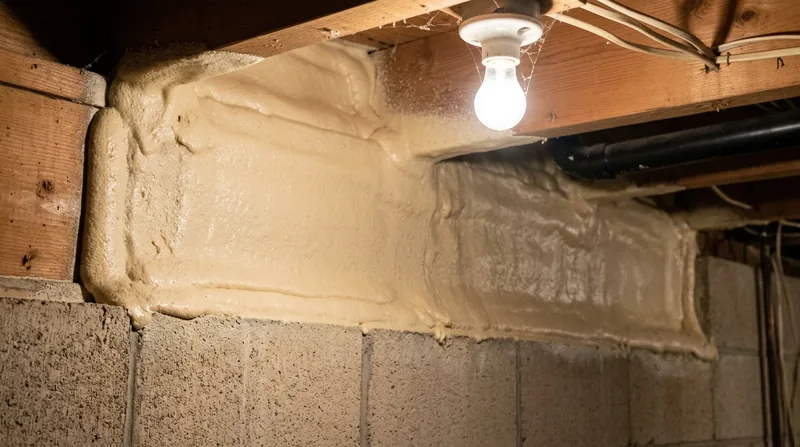




Closed cell spray foam insulation in Rochester delivers rigid insulation and vapor protection suited to the long, cold winters and seasonal humidity swings that dominate Olmsted County homes. Rochester's housing stock, from older downtown neighborhoods near Kutzky Park to mid-century ranches across the city and newer subdivisions stretching toward Byron, Stewartville, and Pine Island, sits almost entirely over full basements, where rim joists at the top of the foundation wall are a constant source of heat loss and winter condensation. In IECC climate zone 6A, the stack effect pulls warm indoor air upward through attic bypasses and uninsulated rim joists, driving heating costs higher every January through March. Closed cell foam stops that air movement, adds R-value per inch without requiring cavity depth, and acts as a vapor retarder when the dew point shifts with the seasons. Whether you are sealing a basement rim joist, insulating a crawl space, or retrofitting a wall cavity in a pre-1980 home, closed cell foam works where open cell cannot and where fiberglass has already failed.
Why Closed Cell Spray Foam Matters in Rochester's Cold Climate
Rochester winters demand insulation that stops air leaks and resists moisture from both directions. The stack effect, warm air rising through the home in winter, pulls conditioned air out of living spaces and into attics and rim joists where it meets cold exterior surfaces. When that warm, moist air cools, it condenses. Fiberglass and cellulose absorb that moisture, lose R-value, and settle over time. Closed cell foam does not absorb water, maintains its R-value through the season, and seals the gaps that fiberglass cannot reach. In crawl spaces and basements under Rochester homes, where humidity and temperature swings are severe, closed cell foam prevents condensation on rim joists and band joists year-round.
- Closed cell foam delivers R-6 to R-7 per inch, allowing thick insulation in tight spaces like rim joists and wall cavities without structural compromise.
- It acts as a vapor retarder, blocking moisture from moving into walls and attics as the dew point reverses between winter and summer.
- Closed cell foam is rigid once cured, providing structural bracing to rim joists and band joists that reduces vibration and noise from foundation movement.
- It seals air leaks around electrical outlets, rim joist rim plates, and band joist edges where fiberglass batts leave gaps.
- Closed cell foam does not absorb moisture, so it maintains performance in Rochester's basement and crawl space environments where humidity is constant.
These qualities make closed cell foam the standard choice for rim and band joist sealing, crawl space insulation, and wall retrofits across Olmsted County and the surrounding areas of Mower, Fillmore, Winona, Wabasha, and Goodhue counties.
Key info: Rochester homes built before 1990 often have rim joists with no insulation at all. A typical full basement rim joist runs 200 to 400 linear feet. Sealing it with 2 inches of closed cell foam stops the stack effect at the foundation level and can reduce basement heating loss by 15 to 25 percent in that zone alone.
For current guidance on permits and building code requirements for spray foam in your Rochester home, check the City of Rochester building department website, as attic ventilation, ignition barriers, and thermal barriers are governed by local energy code and building officials, not by us.
How We Install Closed Cell Spray Foam Insulation in Rochester Homes
Our process starts with a site inspection to identify air leaks, assess substrate condition, and determine the thickness and coverage needed to meet your home's R-value target. We do not spray over wet, leaking, or contaminated surfaces. If moisture is present, we address it first or walk away. Once the substrate is dry and prepared, we set up mechanical ventilation to manage VOC off-gassing during application and cure. We apply closed cell foam in controlled passes, maintaining manufacturer ratio and drum temperature, and we specify the exact thickness and R-value for your job in writing before we start. Re-entry time is 24 to 48 hours, depending on temperature and foam type, and we state that clearly. After cure, we inspect for voids or thin spots and address them before we leave the site.
- We inspect the substrate, identify moisture and air leaks, and document what we find before quoting the job.
- We set up mechanical ventilation and establish a re-entry window of 24 to 48 hours before you occupy the space.
- We apply closed cell foam in controlled passes at the correct drum temperature and manufacturer ratio to ensure proper cure and R-value.
- We specify thickness and R-value in writing for rim joists, walls, crawl spaces, and attics before work begins.
- We inspect the finished foam for voids, thin spots, and coverage gaps and correct any defects on site before we clean up.
This discipline is what separates a professional spray foam job from a rig-and-run crew that sprays in an afternoon, leaves, and is unreachable when the smell will not go away or when the foam does not cure properly.
Example: A rim joist sealing job in a Stewartville ranch home requires 2 to 3 inches of closed cell foam to reach R-12 to R-18, depending on existing cavity depth. We set up ventilation in the basement, apply foam in two passes to avoid over-thickness and poor cure, and verify full coverage along the rim plate and band joist before the homeowner re-enters. The job takes one day, and the basement stays sealed and dry year-round.
For more details on how we handle air sealing alongside closed cell foam, see our air sealing service page.
Closed Cell Spray Foam Methods and Applications
| Application | Description | Best for |
|---|---|---|
| Rim and band joist sealing | 2 to 3 inches of closed cell foam applied to the rim plate and band joist at the top of the foundation wall, sealing the cavity and the rim board itself. | Stopping the stack effect and condensation in basements and crawl spaces across Rochester's full-basement homes. |
| Crawl space insulation | Closed cell foam sprayed on rim joists, band joists, and crawl space walls to seal air leaks and prevent moisture infiltration from the soil and outdoor air. | Crawl spaces in Byron, Stewartville, and surrounding areas where humidity and condensation damage insulation and wood framing. |
| Wall cavity retrofit (injection foam) | Closed cell foam injected into closed wall cavities of pre-1980 homes without removing drywall, filling voids and sealing air leaks within the wall assembly. | Improving R-value and air tightness in older Rochester homes where cavity walls have settled or were never insulated. |
| Sealed attic roof deck | Closed cell foam applied to the underside of roof sheathing to create a conditioned attic space, stopping ice damming and attic heat loss. | Rochester split-level and ranch homes prone to ice damming in winter, where attic bypasses and warm air escape drive heating costs high. |
| Garage ceiling and wall insulation | Closed cell foam applied to garage ceilings and exterior walls to reduce heat loss from attached garages and improve thermal comfort in adjacent living spaces. | Rochester homes with attached garages where uninsulated garage ceilings allow cold air to flow into bedrooms and living areas. |
Closed Cell Spray Foam Insulation Cost in Rochester: What to Expect
Closed cell spray foam is priced by the board foot, measured on site at the thickness you need. Costs start at approximately $1.20 per board foot for material and labor, but that figure moves up or down based on several factors. The primary drivers are the thickness required to reach your R-value target, the area and geometry of the space (rim joists are linear and tight; attic decks are broad and open), substrate condition (wet or contaminated surfaces require remediation before foam can go down), and access (basement rim joists are easy; sealed attic cavities require more setup). A typical rim joist sealing job on a Rochester full-basement home runs 200 to 400 linear feet and costs $800 to $2,000 depending on thickness and cavity depth. A crawl space wall sealing runs higher. A sealed attic roof deck on a ranch or split-level is a larger project and reflects that scope.
The best way to understand cost for your home is to get a written estimate that specifies the thickness, R-value, and board footage for your job. We provide free estimates with no obligation, and we respond within 24 hours. For a detailed pricing overview and examples by service type, see our pricing page.
Why get multiple estimates? Not all spray foam work is equal. A low estimate with no R-value and thickness specification, no mention of mechanical ventilation during cure, or a promise of immediate re-entry is a red flag. Professional estimates include those details and stand behind them in writing. Comparing 2 to 3 estimates from local contractors ensures you understand what you are paying for and can verify that the job will be done right.
What to Look for When Hiring a Closed Cell Spray Foam Contractor Near Me in Rochester
Hiring the right spray foam contractor means verifying that the person or company can do the work, is fully insured, and will stand behind the installation. Rochester has local independent shops, national franchise operations, and transient crews that move from state to state. The independent with a local address and local plates, who can be reached after the job is done, is your best bet. Here is what to check before you sign.
- Verify that the contractor is fully insured and ask for a certificate of insurance listing your address as an additional insured.
- Request a written estimate that includes the thickness, R-value, and board footage of foam, plus the re-entry window and any warranty terms.
- Ask for references from recent jobs in Rochester, Stewartville, Byron, or nearby areas, and call them to ask about the finished work and the contractor's responsiveness after the job.
- Check that the contractor understands local building code and permitting for your city, and confirm that they will help you navigate what applies to your address.
- Confirm that the contractor will set up mechanical ventilation during cure and will not promise re-entry before 24 to 48 hours have passed.
If you are retrofitting a wall or removing old insulation, ask whether the contractor also handles insulation removal, so you do not have to hire a second crew. Ready to get started? Contact us for a free estimate at (507) 577-5314 or fill out our online form. We respond within 24 hours and will walk you through the process, the cost, and what to expect on the day of the job.
Closed Cell Spray Foam Insulation in Rochester: Pricing Guide
| Service | Price | Details |
|---|---|---|
| Rim and band joist sealing | Starting at $1.20/board ft | 2 to 3 inches closed cell foam on full basement rim joists, typically 200 to 400 linear feet per home |
| Crawl space insulation | Starting at $1.20/board ft | Closed cell foam on crawl space walls and rim joists, cost driven by wall height, linear footage, and cavity depth |
| Wall cavity retrofit and injection foam | Starting at $1.20/board ft | Closed cell foam injected into closed wall cavities of pre-1980 homes, priced by board foot and wall area |
| Sealed attic roof deck | Starting at $1.20/board ft | Closed cell foam sprayed under roof sheathing, cost varies by roof size, pitch, and thickness needed for R-value target |
| Garage ceiling and walls | Starting at $1.20/board ft | Closed cell foam on garage ceilings and exterior walls, cost depends on area, substrate condition, and access complexity |
| Free estimate | No charge | Written estimate with thickness, R-value, and board footage specified, response within 24 hours at (507) 577-5314 |
Indicative pricing, the exact cost depends on square footage, finish, and site access. Free personalized estimate within 24h at (507) 577-5314.


