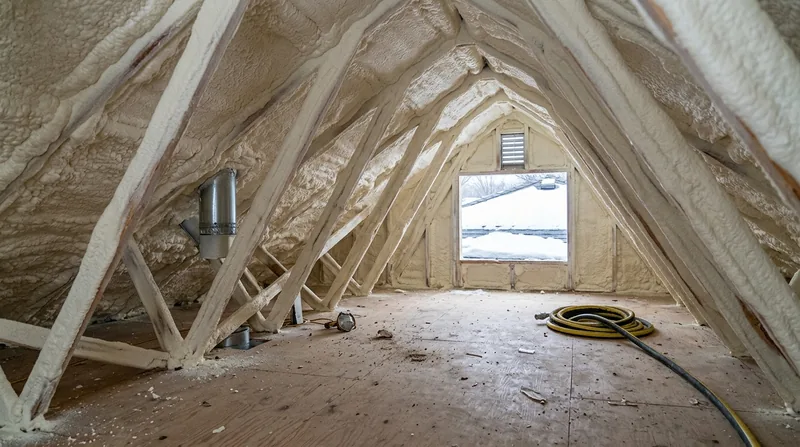




Attic spray foam insulation in Rochester stops the heat loss and ice damming that plague older homes near downtown, mid-century ranches across the city, and newer subdivisions stretching toward Byron and Stewartville. Rochester sits in IECC climate zone 6A, where long winters with wind and snow demand tight attics, and the stack effect pulls warm air upward through bypasses around plumbing vents, electrical chases, and soffit edges. Once that warm air escapes into the attic, the roof warms, snow melts, refreezes at the gutter, and ice dams back water into walls and ceilings. We seal attic bypasses and add spray foam so attics stay closer to roof temperature, stopping the cycle before it starts. The result is lower heating bills, no more ice dams, and a drier attic through the spring thaw.
Why Attic Spray Foam Insulation Matters in Rochester's Climate
Rochester's housing stock sits directly over its vulnerability. Nearly every home here has a full basement, and rim and band joists at the top of the foundation wall leak heat all winter. Above ground, attics on older homes and ranches are riddled with bypasses that traditional fiberglass never seals. The stack effect in winter pulls indoor air upward, carrying heat and moisture into attics where cold roof decks meet warm interior air. That moisture condenses, frost builds on rafters and sheathing, and come spring, you find wet insulation and soft wood. Spray foam stops both the air leakage and the moisture intrusion because it seals the bypass itself, not just sits on top of it.
- Seal attic bypasses around plumbing, electrical, and soffit penetrations that fiberglass cannot reach.
- Stop the stack effect that drives warm interior air into the attic and causes ice damming on roofs.
- Reduce condensation and frost buildup on attic framing and sheathing during cold winters.
- Lower heating costs by keeping attic temperature closer to roof temperature in January and February.
- Prevent water intrusion from ice dams backing up under shingles and into wall cavities.
Sealing attic bypasses and adding continuous insulation is the single most effective way to stop ice damming and lower winter heating bills in Rochester.
Key info: Rochester's older homes near downtown and Kutzky Park, along with ranches across the city, are the most vulnerable to ice damming because their attics have the most bypasses and the least air sealing. A single 4-inch hole around a plumbing vent stack can cost you 40 to 50 dollars a month in winter heating loss.
For more on how air sealing works in combination with insulation, see our air sealing service page.
How We Insulate Rochester Attics: Process and Methods
Every attic job starts with a walk-through to locate bypasses, measure joist depth and rafter spacing, and identify any existing insulation, roof condition, or moisture damage. We then remove old, compressed, or failed insulation if needed, seal all bypasses with spray foam, and add continuous closed-cell or open-cell insulation to the underside of the roof deck or the top of the attic floor, depending on whether you want a sealed (conditioned) attic or a vented attic. The choice depends on your roof age, HVAC location, and whether you have ductwork in the attic. We follow the manufacturer ratio and temperature, maintain mechanical ventilation during cure, and respect the re-entry window so your family is safe when the job is done.
- We inspect the attic, identify all bypasses, and document existing insulation type and condition.
- We remove old or failed insulation if the attic requires a full re-insulation, using our insulation removal equipment.
- We seal every bypass with spray foam, paying special attention to plumbing vents, electrical chases, and soffit edges.
- We apply closed-cell or open-cell foam to the roof deck or attic floor in continuous layers, achieving the R-value and thickness specified in writing before we start.
- We maintain mechanical ventilation during cure, confirm the re-entry window with you, and clean up all equipment and debris.
The entire process typically takes one to three days, depending on attic size and the extent of bypass sealing and insulation removal required.
Example: A 1,200-square-foot attic on a ranch home in Stewartville with fiberglass that has settled and compressed over twenty years, plus seven major bypasses around plumbing and HVAC penetrations, typically takes two days: day one for removal and bypass sealing, day two for foam application and ventilation setup. The homeowner stays out of the attic for forty-eight hours while the foam cures.
Learn more about our insulation removal service if your attic has old or contaminated material.
Spray Foam Methods for Rochester Attics
| Approach | Description | Best for |
|---|---|---|
| Closed-Cell Spray Foam | Dense, rigid foam with R-value around 6.5 per inch. Requires 15-minute thermal barrier or ignition barrier per code. Highly air-tight and moisture resistant. | Sealed attic decks, roof leaks history, high humidity climates, condensation control on metal roofs. |
| Open-Cell Spray Foam | Softer, semi-rigid foam with R-value around 3.5 per inch. Does not require a thermal barrier. Easier to install around obstacles, sound-dampening. | Vented attics, budget-conscious retrofits, sound control, attics with limited roof depth. |
| Closed-Cell with Sealed Attic | Continuous closed-cell foam applied to underside of roof deck, sealing the attic from outside air and moisture. Attic becomes conditioned space. | Homes with HVAC ducts or air handlers in the attic, ice damming prevention, superior moisture control. |
| Attic Floor Insulation with Bypass Sealing | Spray foam applied to attic floor joists after bypass sealing, keeping attic vented. Lower cost, simpler retrofit for sound attics. | Older homes with good roof condition, vented attics, budgets where sealed attic is not required. |
The right method depends on your roof age, whether you have ductwork in the attic, and how much control you want over attic moisture. We help you understand the difference during the free estimate.
Attic Spray Foam Insulation Cost in Rochester: What to Expect
Attic spray foam insulation in Rochester typically starts at $1.50 per square foot for open-cell foam on attic floors, and runs higher for closed-cell, sealed attics, and jobs requiring insulation removal. A 1,200-square-foot attic with moderate bypass sealing and open-cell insulation to R-38 usually falls in the $1,800 to $2,400 range. A sealed attic with closed-cell foam on the roof deck, which requires thicker application and a thermal barrier, typically runs $2,400 to $4,200 for the same footprint. The biggest cost drivers are attic size, the extent of bypass sealing required, whether existing insulation must be removed, and whether you choose open-cell or closed-cell foam.
Get a written estimate that specifies R-value, foam thickness in inches, and the square footage being covered. Any estimate without those details is incomplete. We provide written estimates with R-value and thickness specs so you know exactly what you are paying for and why the price is what it is. The estimate is free, and there is no obligation to book.
See our full pricing page for more detail on what affects cost and how we build an estimate.
Attic Spray Foam Insulation Near Me: What Rochester Homeowners Should Know Before Hiring
Spray foam is a high-performance product, but the quality of the installation is everything. A poorly mixed ratio, incorrect drum temperature, or immediate re-entry before the foam has cured can leave you with a sticky, off-gassing attic and no recourse. When you are evaluating any spray foam contractor, including us, look for these markers of professional work: a written estimate with R-value and thickness, evidence of mechanical ventilation during cure, a clear re-entry window of 24 to 48 hours, and insurance that can be verified with a phone call to the carrier. Ask for references and call them. Confirm that the contractor is familiar with your local building code and will help you understand what permits apply at your address. If you have an HOA, check whether exterior work on roof penetrations or vents requires architectural approval. Do not hire based on price alone, and do not trust any contractor who promises immediate re-entry, skips mechanical ventilation, or cannot produce a written estimate.
- Verify that the contractor carries liability and property damage insurance, and confirm the coverage with a phone call.
- Ask for a written estimate that includes R-value per inch, total thickness in inches, and the square footage of attic being covered.
- Check local references from recent jobs, and ask them about the cure time, any odor, and whether the contractor cleaned up properly.
- Confirm that your local building department requires a permit for attic insulation, and ask whether the contractor will help you navigate the process.
- If you live in a master-planned community, check HOA rules for any approval required on roof vents or soffit work.
The best way to find a qualified spray foam contractor near you is to call us at (507) 577-5314 for a free estimate and ask the questions above. We have been doing this work since 2014, and we are happy to explain our process and answer any concerns you have.
Attic Spray Foam Insulation in Rochester: Pricing Guide
| Service | Price | Details |
|---|---|---|
| Open-Cell Spray Foam, Attic Floor | Starting at $1.50/sq ft | Attic floor insulation with bypass sealing, R-38 to R-49, vented attic, no removal required |
| Closed-Cell Spray Foam, Sealed Attic | Starting at $2.50/sq ft | Roof deck insulation, sealed attic, R-21 to R-30, includes bypass sealing and thermal barrier |
| Insulation Removal + Foam Installation | On estimate | Cost depends on attic size, insulation type, and volume of material to be hauled away and disposed |
| Travel and Setup | Included | Rochester and surrounding Olmsted County areas, no separate mileage fee or call-out charge |
| Written Estimate | Free | Includes R-value, thickness, and square footage. Response within 24 hours at (507) 577-5314 |
Indicative pricing, the exact cost depends on square footage, finish, and site access. Free personalized estimate within 24h at (507) 577-5314.


