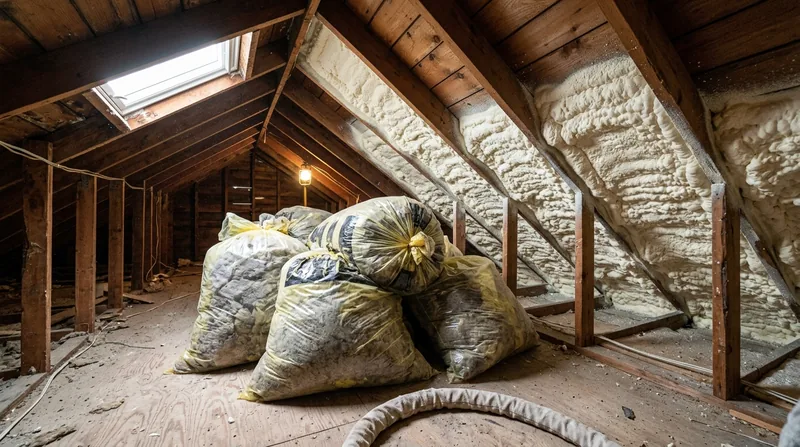




Insulation Replacement & Re-Insulation in Rochester means tearing out failed or undersized insulation and installing spray foam that actually seals the air leaks driving your heating bills. Rochester's older homes near downtown, mid-century ranches across the city, and newer subdivisions toward Byron and Stewartville all sit over full basements and face the same winter problem: heat escapes through rim joists, attic bypasses, and uninsulated wall cavities, while the stack effect pulls warm air upward and ice dams form on roofs. In climate zone 6A, with long cold winters and humidity that reverses direction between January and July, replacing deteriorated fiberglass or blown-in cellulose with closed or open cell foam stops that leak at the source. We remove old insulation, seal the air paths, and install spray foam to the R-value and thickness your home needs to handle Rochester winters and the seasonal dew point shifts that damage walls and attics. Learn how spray foam insulation works across all our services, or call us at (507) 577-5314 for a free estimate.
Why Insulation Replacement Matters in Rochester's Older Neighborhoods and Newer Subdivisions
Old insulation fails. Fiberglass settles, compresses, and loses R-value. Cellulose absorbs moisture and sags. Vermiculite sits inert but offers no air sealing. Foam that was installed thirty years ago may have shrunk or cracked, leaving gaps that let conditioned air escape and outdoor moisture creep in. In Rochester's rim joists and attic rim board areas, that failure is especially costly because the stack effect concentrates the leak and the winter-to-summer dew point reversal stresses the boundary between conditioned and unconditioned space. Replacing that insulation with spray foam stops the air leak, adds R-value, and prevents the condensation cycle that rots wood and feeds mold.
- Fiberglass and cellulose lose thermal performance as they settle and absorb moisture over time.
- Spray foam seals air paths that blown-in insulation cannot reach, especially in rim joists and attic bypasses.
- Replacing failed insulation before winter arrival stops the ice dam cycle and reduces heating load immediately.
- A written estimate with R-value and thickness specifications ensures the new insulation meets code and your home's needs.
When old insulation has failed, replacement is not optional; it is the foundation of energy efficiency in a Rochester home.
Key info: Rochester's building code is enforced by the city building official and varies by neighborhood. Rim joist insulation, attic air sealing, and thermal barrier requirements are governed by the energy code in force at your address. We help you understand what applies to your home, but the building department makes the final call on permits and method. Check with Rochester's building office or your local city hall before work begins.
For guidance on what the state and local codes require, visit the Minnesota Pollution Control Agency or contact your city building department directly.
How We Remove Old Insulation and Install Spray Foam Replacement in Rochester
Insulation replacement starts with removal. We extract old fiberglass, cellulose, or failed foam from attics, walls, crawl spaces, and rim joists. We bag and haul the material off site. Once the cavity is clean and any moisture issues are addressed, we spray new foam to the thickness and R-value specified in the estimate. The substrate must be dry; if it is wet or contaminated, we stop and address the moisture first. Mechanical ventilation runs during cure, and the re-entry window is twenty-four to forty-eight hours. Read more about our insulation removal process to understand the precondition of every retrofit job.
- We remove all old insulation, debris, and loose fill from the target cavity by hand or vacuum.
- The cavity is inspected for moisture, leaks, or contamination before any new foam is applied.
- Spray foam is applied in controlled passes at the manufacturer-specified ratio and drum temperature.
- Mechanical ventilation operates during cure to control VOC and ensure proper off-gassing.
- We verify thickness and R-value with calipers and document the installation in writing.
The entire process from removal through final inspection takes one to three days depending on the cavity size and complexity.
Example: A ranch-style home in Stewartville with a failed attic insulation layer and settling fiberglass in the rim joist cavities. We remove both, seal the air paths with closed cell foam in the rim joist (which controls condensation), and install open cell foam in the attic (which is cost-effective and breathable). The homeowner avoids ice dams, reduces heating bills, and the attic stays dry year-round.
See how attic spray foam insulation works and learn about rim joist and band joist spray foam for the two most common replacement scenarios in Rochester homes.
Insulation Replacement Methods and Materials
| Approach | Description | Best for |
|---|---|---|
| Closed Cell Spray Foam Replacement | High-density foam with an R-value of 6 to 7 per inch; excellent air and moisture barrier; dense and rigid. | Rim joists, band joists, basement walls, and areas where condensation control is critical in Rochester's humid summers. |
| Open Cell Spray Foam Replacement | Low-density foam with an R-value of 3.5 to 4 per inch; softer and lighter; allows some vapor permeability. | Attics and wall cavities where breathability is desired and condensation risk is low; cost-effective for large areas. |
| Blown-In Cellulose or Fiberglass Top-Up | Loose-fill insulation sprayed or blown into cavities; lower cost; no air sealing; settles over time. | Only when the existing attic insulation is sound and a simple R-value boost is needed, and the homeowner accepts future settling. |
| Injection Foam Wall Replacement | Closed cell foam injected into closed wall cavities without demolition; seals air and moisture; retrofit-friendly. | Pre-1980 Rochester homes with empty wall cavities; avoids tearing down plaster or drywall. |
Choosing the right method depends on the cavity type, moisture risk, and your budget. We recommend closed cell for rim joists and open cell for attics in Rochester's climate zone 6A.
Insulation Replacement and Re-Insulation Cost in Rochester: What to Expect
Insulation replacement cost in Rochester starts at $2,800 for a small rim joist or attic area and scales with the cavity size, insulation type, and removal complexity. A full attic replacement on a mid-size ranch or split-level home typically runs $4,500 to $8,000 depending on square footage and whether closed cell or open cell foam is used. Wall injection foam retrofits on older homes near downtown or in established neighborhoods run $2,000 to $5,000 per wall section. Crawl space replacement with closed cell foam is more expensive because condensation control is critical, and the work is labor-intensive. The biggest cost drivers are cavity size, the amount of old insulation to remove, access difficulty, and foam type. Getting 2 or 3 estimates with written R-value and thickness specifications helps you compare apples to apples. See our full pricing overview for detailed ranges by service type.
- Attic replacement is the largest typical project and determines the bulk of most residential re-insulation budgets.
- Rim joist and band joist insulation is a smaller, high-value entry point that prevents ice dams and condensation damage.
- Wall injection foam avoids demolition and is the most cost-effective way to insulate closed cavities in older homes.
- Removal labor and haul-off add to the total; a written estimate should itemize removal separately from installation.
- Mechanical ventilation, curing time, and re-entry windows do not add material cost but are non-negotiable for proper installation.
A free, written estimate with R-value and thickness specifications is the only reliable way to know the real cost for your home.
What to Look for When Hiring an Insulation Contractor Near Me in Rochester
Finding a trustworthy spray foam insulation contractor near Rochester means verifying insurance, getting multiple estimates, and understanding how the contractor approaches removal, moisture control, and installation. The trade includes both rig-and-run crews (an out-of-state trailer, a job sprayed in an afternoon, no follow-up when the smell lingers) and national franchises, as well as local independents. The differentiator is honest guidance and correct technique: a contractor who gives you a written estimate with R-value and thickness, who explains why closed cell is needed in a rim joist and open cell works in an attic, and who walks away from a wet substrate is the one to hire. Ask about insurance coverage, verify it with the carrier, and confirm that the contractor is fully insured. Request references from recent jobs in Rochester, Stewartville, Kasson, or Byron, and call them. If your home is in a historic district or HOA community, check local architectural or HOA rules before work begins; insulation itself is rarely restricted, but exterior work on metal buildings or crawl space access may be. Contact us for a free estimate and references, and always verify any contractor's credentials and insurance before signing.
- Request a written estimate that includes R-value, foam thickness in inches, and the square footage or board footage being insulated.
- Ask about insurance coverage and confirm it directly with the carrier; "fully insured" is the standard credential in this trade.
- Call at least two references from recent insulation replacement jobs in Rochester or nearby cities.
- Verify that the contractor uses mechanical ventilation during cure and can state a re-entry window of twenty-four to forty-eight hours.
- Ask whether the substrate must be dry and what happens if moisture is found; the answer should be "we fix the moisture first or we walk away."
- Check with your city building department about permit requirements for insulation replacement in your neighborhood.
A local contractor with a local address, local plates, and a track record in Rochester's neighborhoods is your best safeguard against poor installation and unresponsive service.
Insulation Replacement & Re-Insulation in Rochester: Pricing Guide
| Service | Price | Details |
|---|---|---|
| Rim Joist & Band Joist Replacement | Starting at $2,800 | Removal of old insulation, closed cell foam installation to seal air and moisture. Price scales with linear footage of rim joist and complexity of access. |
| Attic Insulation Replacement | Starting at $4,500 | Full removal of old fiberglass or cellulose, spray foam installation at specified R-value. Price depends on attic square footage, access, and foam type selected. |
| Wall Injection Foam Retrofit | Starting at $2,000 | Closed cell foam injected into closed wall cavities without demolition. Price per wall section varies by cavity size and existing insulation condition. |
| Crawl Space Replacement | On estimate | Removal and closed cell foam installation for moisture and condensation control. Requires on-site inspection to assess moisture, access, and structural conditions. |
| Travel & Service Area | Included | No separate mileage fee for jobs in Rochester and surrounding Olmsted, Mower, Fillmore, Winona, Wabasha, and Goodhue counties. |
| Free Estimate | No charge | Written estimate with R-value, thickness, and square footage. Response within 24 hours at (507) 577-5314. No obligation to book. |
Indicative pricing, the exact cost depends on square footage, finish, and site access. Free personalized estimate within 24h at (507) 577-5314.


