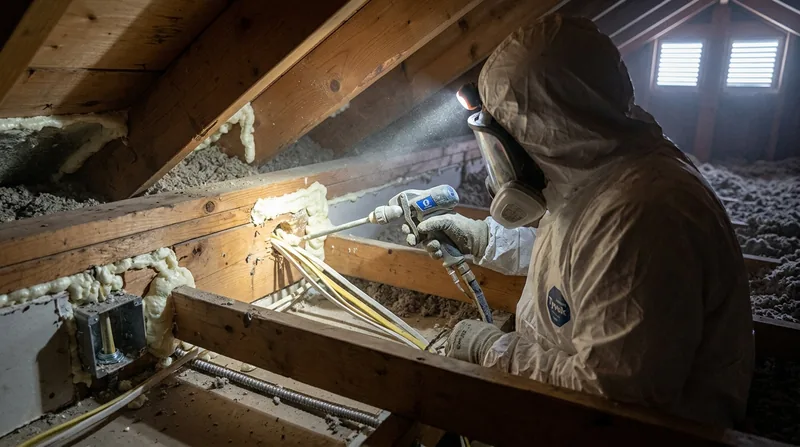




The stack effect in Rochester homes pulls warm air upward through attics each winter, driving heat loss and ice damming along roof edges. Air sealing stops that leak by closing penetrations, sealing top plates, and blocking the pathways that let conditioned air escape into unconditioned space. Rochester's climate zone 6A demands tight control: long cold winters with snow and wind reverse the vapor drive by summer, stressing both old downtown homes near Kutzky Park and the mid-century ranches and split-levels that fill the city from Slatterly Park to the newer subdivisions toward Byron, Stewartville, and Kasson. Nearly every Rochester home sits over a full basement, which means rim and band joists at the foundation top are constant sources of heat loss and condensation. Air sealing is the foundation of energy performance; without it, insulation alone cannot stop the draft. We identify and seal the actual air paths that drive winter heating bills across Olmsted County and the surrounding counties.
Why Air Sealing Matters in Rochester's Climate
Rochester winters are long and cold, and the stack effect is relentless. Warm air naturally rises, and every gap in your attic floor, every unsealed penetration around plumbing and electrical, and every crack in the top plate becomes a pathway for heated indoor air to escape. When that happens, your furnace runs longer, your heating bills climb, and ice dams form along roof edges because heat is leaking out of the attic into the soffit and eaves. Air sealing stops the leak at the source. We target the actual air paths that the stack effect exploits, not just the obvious gaps. Older homes downtown and mid-century ranches across Rochester are especially vulnerable because they were built before modern air-sealing standards, and many have been added to or modified over decades, creating hidden penetrations that pull air upward.
- We seal the top plate where the attic floor meets the exterior walls to block air from rising into the attic cavity.
- We close penetrations around plumbing vent stacks, electrical conduit, HVAC ducts, and furnace flues that create direct paths to unconditioned space.
- We block soffit and eave voids where air leaks sideways and upward, especially on older homes with complex roof lines.
- We seal around attic access doors and pull-down stairs, which are often the single largest uncontrolled gap in the attic floor.
- We address rim joist gaps at the foundation top, where the band joist meets the sill plate, stopping air from entering the basement and cold from rising into first-floor rooms.
Stopping the stack effect is the most cost-effective way to cut winter heating bills and eliminate ice damming risk across Rochester and the surrounding areas of Dodge Center, Kasson, and Stewartville.
Key info: Rochester's IECC climate zone 6A means your attic can lose 30 to 50 percent of heated air through unsealed penetrations and top plates alone. A single 1-inch gap around a plumbing vent or a poorly sealed attic access door can pull as much heat as an open window in winter.
For more on how air sealing works with attic spray foam insulation, see our attic spray foam insulation page.
For permit and building code questions specific to your Rochester address, contact the City of Rochester Building Services Division. Attic ventilation, thermal barriers, and ignition barriers are governed by the energy and building code in force at your location and by your local building official, not by us. We help you navigate what applies.
How We Seal Air Leaks in Rochester Attics and Rim Joists
Air sealing is a step-by-step process. We start with a walkthrough to identify the actual air paths: top plates, penetrations, soffit voids, rim joists, and any modifications or damage that has created gaps. We then seal each path using the right material for the location and the substrate. Some penetrations get spray foam to fill and expand; others get caulk, weatherstripping, or rigid foam board. The key is to seal the air path without blocking ventilation where it is required by code. We do not seal over wet, contaminated, or leaking substrates. If moisture or a roof leak is present, we fix the source first or we walk away.
- We inspect the entire attic floor and identify every gap, crack, and penetration that allows air to rise into unconditioned space.
- We seal the top plate with caulk or foam where it meets the exterior walls, closing the primary pathway for the stack effect.
- We close plumbing vent stacks, electrical conduit, and HVAC ducts with spray foam or rigid foam, expanding to fill voids completely.
- We seal attic access doors and pull-down stairs with weatherstripping and caulk, or replace them with insulated doors if the original is beyond repair.
- We seal soffit and eave voids on the exterior side of the top plate, stopping air from leaking sideways and upward through the roof structure.
- We inspect and seal rim joists at the foundation top, closing the gap between the sill plate and the band joist where cold air enters and heat escapes.
The entire process is driven by what we actually see and measure on site. There is no template; every Rochester home is different.
Local example: A 1960s split-level in southeast Rochester near Pine Island Road had ice damming along the entire north roof edge each winter. An inspection showed the attic access door was unsealed, the top plate had multiple cracks, and a plumbing vent stack had a 2-inch gap around it. Air sealing these three items stopped the ice dam and cut heating bills by 12 to 18 percent the following winter.
For more on how air sealing pairs with closed cell spray foam for maximum thermal resistance, see our closed cell spray foam page.
Air Sealing Methods and Materials
| Method | Description | Best For |
|---|---|---|
| Spray Foam Sealing | Low-pressure polyurethane foam expands to fill voids around plumbing, electrical, and HVAC penetrations. Expands 25 to 30 times its applied volume and hardens to create an air-tight seal. | Large or irregular gaps, rim joists, soffit voids, complex penetrations where caulk alone cannot seal. |
| Caulk and Sealant | Polyurethane or silicone caulk applied to cracks, seams, and small gaps in top plates and around penetrations. Flexible, durable, and paintable. | Top plate cracks, small gaps around ducts and pipes, seams in rim joists and sill plates. |
| Weatherstripping | Adhesive-backed foam or rubber strips applied to moving parts like attic access doors and pull-down stairs. Compresses when the door closes to create an air seal. | Attic hatches, pull-down stairs, attic doors where air leaks around the frame when closed. |
| Rigid Foam Board | Extruded polystyrene or polyisocyanurate boards cut and fitted to seal large openings or soffit voids. Sealed at edges with foam or caulk to prevent air bypass. | Soffit voids, large rim joist gaps, attic access doors that need both air sealing and insulation value. |
The method we choose depends on the gap size, the substrate, code requirements for ventilation, and whether the seal needs to hold insulation value or just block air movement. We never use a single approach for every job.
Air Sealing Cost in Rochester: What to Expect
Air sealing cost in Rochester typically starts at $650 for a focused job targeting the top plate and major penetrations in a single-story attic. Larger homes, complex roof lines, multiple penetrations, or rim joist sealing in addition to attic work will cost more. The main factors that affect price are attic size, the number and complexity of penetrations, access difficulty, and whether rim joists are included. A mid-sized ranch or split-level with straightforward attic access and five to eight major penetrations usually falls in the $800 to $1,400 range. Homes with complex roof lines, soffit voids, or extensive rim joist sealing can run higher.
We always provide a written estimate with R-value and thickness specifications so you know exactly what you are getting and why the price is what it is. We recommend getting 2 to 3 estimates from different contractors so you can compare scope, materials, and pricing. The lowest bid is often the lowest quality; the highest is sometimes the highest overhead. The middle bid from a contractor who can explain their approach and show their work is usually the best value.
For a detailed pricing breakdown and to see how air sealing fits into your overall insulation and energy plan, visit our pricing page. Call us at (507) 577-5314 for a free, no-obligation estimate within 24 hours.
What to Look for When Hiring an Air Sealing Contractor Near Me in Rochester
Hiring the right air sealing contractor is critical because poor work will not stop the stack effect, and shortcuts like skipping top plate sealing or leaving penetrations unsealed will waste your money. The spray foam and air sealing industry has three types of operators: local independent shops with a local address and local accountability, national franchises with regional crews, and rig-and-run outfits that show up in a trailer, spray a job in an afternoon, and disappear when the smell will not go away or the foam shrinks. We are a local independent, and we stand behind our work because we live here.
When you are evaluating any air sealing contractor near Rochester, ask these questions:
- Does the estimate include R-value and thickness specifications for every seal, so you know what you are paying for?
- Can the contractor explain why they chose spray foam versus caulk versus weatherstripping for each gap, and does their reasoning match the job?
- Will they provide references from recent jobs in Rochester, Byron, Stewartville, or Kasson that you can call and verify?
- Are they fully insured, and can they provide proof of insurance that covers property damage and liability?
- Do they commit to mechanical ventilation during spray application and a stated re-entry window of 24 to 48 hours, or do they promise immediate occupancy?
- Will they walk away if the attic has moisture, a roof leak, or a contaminated substrate, or do they seal over it anyway?
Verify any contractor's credentials, including ours. Permitting and contractor registration vary from city to city across Greater Rochester, and there is no reciprocity between cities, so always check with your local building department about what applies at your address. HOA architectural rules rarely touch insulation, but do confirm if your home is in a master-planned community.
Ready to get started? Contact us for a free estimate or call (507) 577-5314. We have been in business since 2014 and serve Rochester and all surrounding areas including Dodge Center, Eyota, Kasson, Oronoco, Pine Island, Stewartville, and beyond.
Air Sealing in Rochester: Pricing Guide
| Service | Price | Details |
|---|---|---|
| Attic Top Plate and Penetration Sealing | Starting at $650 | Sealing top plate cracks and major plumbing, electrical, and HVAC penetrations in single-story attics with good access. |
| Attic Plus Rim Joist Sealing | Starting at $950 | Complete attic air sealing plus rim joist and band joist sealing at the foundation top, addressing both vertical and horizontal air paths. |
| Complex or Multi-Story Home | On estimate | Homes with complex roof lines, multiple attics, extensive soffit voids, or difficult access require on-site inspection before pricing. |
| Travel and Mobilization | Included | No separate call-out or mileage fee for Rochester and all surrounding service areas including Dodge Center, Kasson, and Stewartville. |
| Estimate | Free | Written estimate with R-value and thickness specs, response within 24 hours at (507) 577-5314, no obligation to book. |
Indicative pricing, the exact cost depends on square footage, finish, and site access. Free personalized estimate within 24h at (507) 577-5314.


