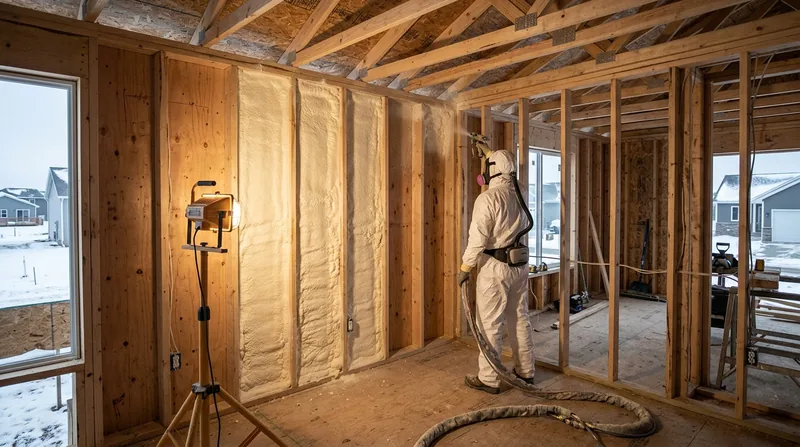




Commercial and new construction spray foam insulation in Rochester requires planning that starts before framing closes. Olmsted County's Zone 6A climate demands insulation sized for long, cold winters with snow and wind, plus humid summers that reverse vapor drive seasonally. Commercial buildings and new homes across Rochester, Byron, Stewartville, Kasson and Pine Island need air sealing and thermal control in walls, attics and rim joists before drywall and roofing go in. We work with builders and commercial contractors to specify closed cell and open cell foam systems that meet energy code, control condensation on metal and wood, and hold their R-value through decades of Minnesota weather. The difference between a building that stays dry and tight versus one that develops moisture problems, ice dams and heating loss often comes down to decisions made in the framing stage, when insulation work is still accessible and affordable.
Why Commercial and New Construction Spray Foam Matters in Rochester's Building Climate
Rochester's older commercial buildings and new construction sites face a shared problem: the stack effect and seasonal moisture reversal. Warm air rises in winter, pulling dry indoor air upward through rim joists, attic bypasses and wall penetrations. That same upward pressure, combined with uninsulated band joists at the top of foundation walls, accounts for much of the heating loss across commercial buildings and new homes in the city. In summer, exterior humidity pushes moisture toward attic edges and rim joists, where it can condense on cold surfaces if insulation and air sealing are not continuous. Builders who seal and insulate before drywall goes in avoid expensive retrofit work later and protect the building envelope from the start.
- Spray foam closes air leaks at rim joists, band joists and wall cavities before they become hidden in the finished building.
- Closed cell foam controls condensation on metal roof decks and steel framing by creating a continuous vapor barrier.
- Open cell foam in walls and attics allows drying and is code-approved when paired with the correct thermal barrier.
- Sealed attics and unvented roof decks reduce the stack effect and prevent ice damming on low-slope roofs common in Rochester commercial buildings.
- New construction insulation installed during framing costs far less per board foot than retrofit work done after the building is enclosed.
Builders who plan insulation and air sealing into the framing schedule avoid delays and deliver buildings that perform reliably in Minnesota's climate.
Key info: Rochester commercial buildings and new construction are subject to the Minnesota Energy Code and local building permits. Permitting requirements, thermal barrier specifications and attic ventilation rules vary by city and building use. Always defer to the local building official at your address. We help navigate what applies to your project and coordinate with your builder and municipality.
For more on how air sealing complements insulation work, see our air sealing service page.
How We Approach Commercial and New Construction Spray Foam in Rochester
Commercial and new construction projects in Rochester require coordination with builders, general contractors and the building official. We start with a site walk during framing to identify rim joists, wall cavities, roof deck penetrations and mechanical chases that need insulation and air sealing. We measure board footage, specify R-value and foam type based on code, building use and the local climate. Then we schedule application to fit the framing timeline, apply foam at the correct ratio and thickness, and provide written documentation of what was sprayed, where, and to what R-value. Mechanical ventilation during cure and a forty-eight-hour re-entry window protect indoor air quality during application.
- We conduct an on-site walk with the builder or contractor to identify all areas that require insulation and air sealing.
- We provide a written estimate with R-value, thickness and board footage for each section of the building envelope.
- We coordinate spray dates to fit the framing and drywall schedule without delaying the project.
- We apply foam at the manufacturer-specified ratio, drum temperature and thickness, with mechanical ventilation during cure.
- We document the completed work with photos and a summary showing what was sprayed, location and R-value achieved.
This approach keeps commercial and new construction projects on schedule and ensures the building envelope is sealed and insulated before it is closed in.
Example: A new commercial office building in downtown Rochester required closed cell foam on the underside of the roof deck to create a sealed attic and prevent condensation on the steel structure. A new residential subdivision near Byron needed rim joist and band joist sealing on all homes before basement drywall. In both cases, coordinating the spray schedule during framing kept the project timeline intact and eliminated costly retrofit work later.
Learn more about closed cell spray foam for metal buildings and sealed roof decks.
Commercial and New Construction Spray Foam Methods for Rochester Buildings
| Approach | Description | Best for |
|---|---|---|
| Closed Cell Foam on Roof Decks | High-density spray foam applied to the underside of metal or wood roof decks, creating an unvented sealed attic and continuous vapor barrier. | Metal buildings, commercial roofs, barndominiums and new construction where condensation control and R-value are critical. |
| Rim Joist and Band Joist Sealing | Closed cell or open cell foam applied to the band joist at the top of the foundation wall, sealing the rim cavity and air leaks. | New residential construction, commercial buildings with basements and retrofit projects where the rim is exposed during framing. |
| Wall Cavity Foam | Open cell spray foam applied to wall cavities during framing, filling the space between studs and blocking air infiltration. | New construction exterior walls, interior partition walls requiring sound dampening and commercial buildings where air sealing is essential. |
| Mechanical Chase and Penetration Sealing | Closed cell foam applied around HVAC ducts, electrical chases, plumbing penetrations and other openings in the building envelope. | Any new commercial or residential construction where mechanical systems pass through the building envelope. |
Commercial and New Construction Spray Foam Cost in Rochester: What to Expect
Commercial and new construction spray foam pricing in Rochester depends on the building size, the complexity of the roof deck or wall assembly, foam type and the square footage or board footage to be sprayed. A new home with rim joist and band joist sealing might start at one price point, while a commercial metal building with a fully sealed roof deck will be higher. The best way to understand cost is to request a free commercial estimate. We measure the building during the framing stage, specify the R-value and foam type required by code, calculate the board footage needed and provide a written quote with R-value and thickness noted for each section. This approach ensures you see exactly what the project will cost before any work begins.
Several factors move the cost up or down. A simple rim joist sealing on a straightforward rectangular building costs less per board foot than a complex roof deck with multiple penetrations, skylights and mechanical chases. Metal buildings with large open spans require more closed cell foam than wood-frame buildings. New construction where the envelope is open and accessible costs less to spray than retrofit work where walls are already closed in. Access to the building, the distance from our shop in Rochester and the urgency of the timeline can also affect pricing. The best practice is to get a free written estimate from us and at least one other contractor so you can compare R-value, thickness and price side by side.
See our full pricing overview for typical ranges and service details.
What to Look for When Hiring a Commercial and New Construction Spray Foam Contractor Near Rochester
Hiring the right spray foam contractor for commercial or new construction work in Rochester requires the same diligence you would apply to any trade. The spray foam industry includes local independent shops, national franchises and rig-and-run crews that spray a job in an afternoon and disappear when the smell does not clear or the foam shrinks. You should verify that any contractor you hire is fully insured and can provide proof of coverage. Ask for references from recent commercial or new construction projects in Rochester, Stewartville, Kasson or nearby areas. Request a written estimate that includes R-value and thickness for each section of the building, not just a dollar amount per board foot. Understand what happens if the substrate is wet or contaminated. A reputable contractor will walk away from a job rather than spray over moisture or a leaking roof.
- Confirm that the contractor is fully insured and ask to see a current certificate of insurance.
- Request references from commercial or new construction projects completed in the last two years.
- Ask for a written estimate that specifies R-value, thickness and board footage, not just a price per square foot.
- Verify that the contractor understands local building code requirements and can coordinate with your building official.
- Confirm that the contractor uses mechanical ventilation during cure and specifies a re-entry window of at least forty-eight hours.
- Ask whether the contractor will walk away from wet substrates or contaminated surfaces rather than spray over them.
A contractor who provides transparent estimates, references and clear communication about methods and timelines is the one to trust with your commercial or new construction project. Contact us at (507) 577-5314 or visit our contact page for a free estimate and to discuss your project timeline.
Commercial & New Construction Spray Foam in Rochester: Pricing Guide
| Service | Price | Details |
|---|---|---|
| Free Commercial Estimate | Free | On-site walk, measurement, R-value and foam type specification, written quote with board footage and thickness |
| Rim Joist and Band Joist Sealing | Starting at $800 | Closed cell or open cell foam applied to foundation wall band joist, includes labor and material for typical residential lot |
| Commercial Roof Deck Sealing | Starting at $2,500 | Closed cell foam applied to underside of roof deck, price varies with deck size, slope, penetrations and accessibility |
| Wall Cavity Foam (New Construction) | Starting at $1,200 | Open cell spray foam in exterior and interior wall cavities, price scales with wall square footage and complexity |
| Travel and Setup | Included | No separate mileage fee or travel charge within Rochester and surrounding Olmsted County service area |
Indicative pricing, the exact cost depends on square footage, finish, and site access. Free personalized estimate within 24h at (507) 577-5314.


